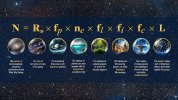
True, but if you do the math the chances of us encountering a sentient alien species are abysmal at best.
Let's assume 1 out of every thousand worlds has multicellular life. That's 1,000,000,000,000,000,000 worlds, 1 quintillion.
Let's assume out of those 1 quintillion multicellular worlds that 1 in 1000 has something resembling animals. 1,000,000,000,000,000. That's 1 quadrillion worlds with animal life.
Let's assume 1 in 10 of those have some sort of sentient life that has developed the use of tools, even if they are primitive. That's 10 TRILLION worlds.
10 trillion worlds scattered among 100 billion galaxies gives an average of 100 tool-building worlds in our galaxy. Then you have 13.8 billion years to spread those out over.
Also consider that any planet with a gravitational field even slightly stronger than Earth's would make it impossible to reach space with chemical rockets, which would likely cause any space program to just not happen, barring some radical technological developments, unless they were using something like electromagnetic mass drivers to launch probes only....
Ok lets be more generous...
Say 1 in 2 stars has a planet or moon that supports life. 500,000,000,000,000,000,000,000 planets with life. Say 1 in 2 of those has tool-building life, 250,000,000,000,000,000,000,000.
Now, let's assume that in the first billion years of our galaxy, there were ZERO tool-building species. That leaves you with 12.21 billion years to divide 25,000 civilizations over a galaxy with a 100,000-180,000 light-year diameter. Let's assume 140,000 light-years. That's more than 15,000,000,000 square light-years.
That gives us 1 tool-building civilization per 600,000 square light-years spread out over 12 billion years...
UAPs/UFOs probably aren't aliens.